Key Takeaways:
- Institutions keep staking ETH despite falling yields, signaling long-term conviction.
- Over 40 million ETH is now locked, tightening circulating supply.
- Regulatory clarity and ETFs continue driving institutional staking demand.
Yield is supposed to be the reason capital moves. Right now, institutions are staking record amounts of Ethereum even as the return for doing so keeps shrinking — a pattern that says more about conviction than it does about income.
Bitwise’s Q3 2026 Staking Report shows a record 40.2 million ETH, or 33% of supply, is now staked, with most of the new stake this year coming from institutions — staking ETFs, corporate treasuries, and other large holders who added stake even as prices fell.

The Yield Keeps Compressing, But the Stake Keeps Growing
The math behind Ethereum’s staking design means yield falls as more ETH gets locked up. Staking currently generates a 2.84% annual yield through consensus layer rewards, a figure mathematically linked to validator count — as total stake increases, the base reward rate gradually decreases to maintain sustainable issuance. That’s a meaningful drop from where things stood even a few months earlier: native staking APR had already compressed to roughly 2.78% base APR by late May, down from the 4%-plus yields seen in 2023.
Despite that decline, the queue to stake more ETH hasn’t slowed. Roughly 2.6 million ETH was recently queued for staking over a 45-day window — against an existing base of 40 million, that’s an additional 6.5% jump in locked supply. Analysts framed the pattern directly: investors are continuing to lock up ETH despite lower yields, a sign that long-term conviction, rather than yield alone, is driving staking demand.
What The Chart Shows Around This Milestone
Looking at the weekly chart, ETH has spent 2026 in a wide, volatile range — climbing above $2,200 earlier in the year before a sharp correction pulled price down toward $1,600 in recent weeks. ETH trades at $1,855.86 on the weekly chart, down 3.02% from the prior close, according to TradingView data via Binance.
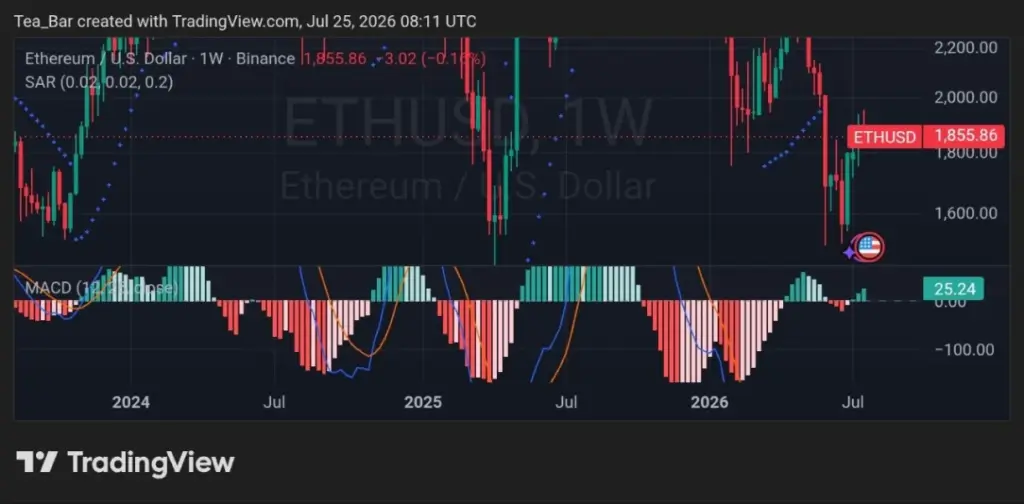
A recovery attempt has since lifted ETH back toward $1,855, though the token remains well off its 2026 highs. The MACD indicator shows momentum turning positive again after a deep negative stretch, with the histogram flipping green in the most recent weeks — a technical echo of the same accumulation pattern showing up in the staking data.
Where the Institutional Demand Is Coming From
Corporate treasuries have become one of the more visible drivers of this trend. BitMine, for example, generated $45.7 million in ETH staking revenue over the three months ended May 31, 2026, while staking approximately 4.9 million ETH.
Regulated products have added another channel entirely: a joint SEC and CFTC interpretive release on March 17, 2026 classified staking rewards as non-securities, clearing a legal barrier that had delayed staking-enabled ETFs for over a year, opening the door for issuers to add yield distribution directly into existing spot Ethereum ETF products.
Locked Supply, Not Idle Capital
Ethereum isn’t alone in this pattern — Solana’s staking ratio sits at 68%, Near at 45%, Hyperliquid at 44%, and Avalanche at 41%, with staking activity spreading into newer networks as well. But Ethereum’s scale makes its number the one worth watching most closely.
A third of ETH’s entire circulating supply is now committed to validator contracts rather than sitting liquid on exchanges — supply that isn’t available to sell regardless of what happens to price next. Whether that structural tightening eventually shows up in a stronger chart, or simply continues quietly in the background, is the open question institutions appear willing to wait out.
- Broker
- Min Deposit
- Score
- Visit Broker

- Award-winning Cryptocurrency trading platform
- $100 minimum deposit,
- FCA & Cysec regulated

- 20% welcome bonus of upto $10,000
- Minimum deposit $100
- Verify your account before the bonus is credited


- Fund Moneta Markets account with a minimum of $250
- Opt in using the form to claim your 50% deposit bonus
Learn to Trade
Never Miss A Trade Again

Signal Notification
Real-time signal notifications whenever a signal is opened, closes or Updated

Get Alerts
Immediate alerts to your email and mobile phone.

Entry Price Levels
Entry price level for every signal Just choose one of our Top Brokers in the list above to get all this free.