For years, blockchain networks have largely operated in isolation, forcing users to rely on centralized exchanges or third-party bridges to move assets between ecosystems. While these methods have enabled cross-chain activity, they have also introduced additional costs, delays, and security concerns.
The latest collaboration between Cardano and Injective suggests that the industry is moving toward a future where independent blockchains can communicate more naturally. Although the integration is still on a testnet and not yet ready for production, it offers a glimpse of how blockchain interoperability could reshape decentralized finance.
Why This Development Matters
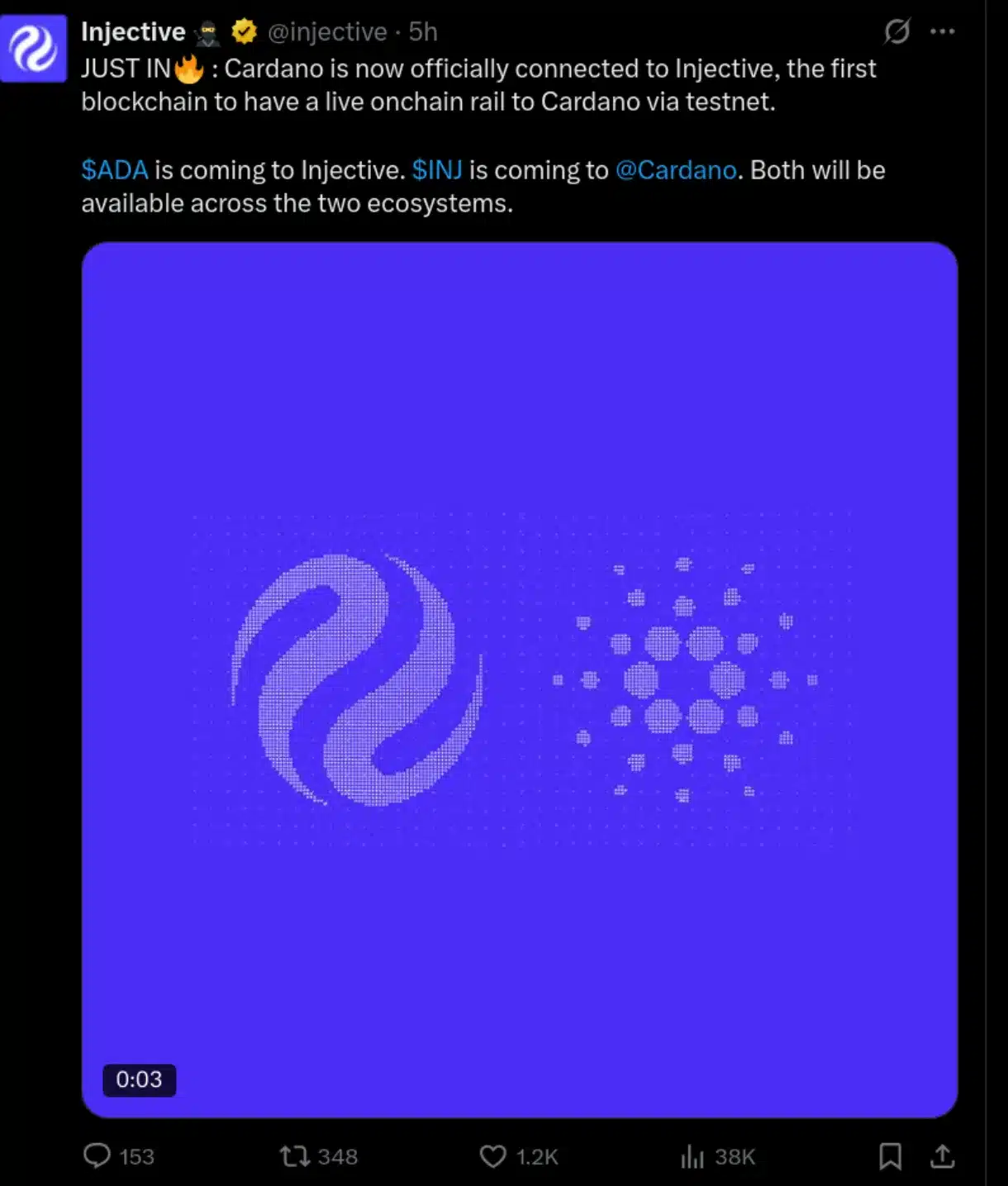
The newly activated Inter-Blockchain Communication (IBC) testnet connection allows native ADA to move into the Injective ecosystem while enabling INJ to travel to Cardano without relying on wrapped assets or centralized intermediaries.
Although this remains an experimental implementation, it demonstrates that two fundamentally different blockchain architectures can exchange assets through a standardized communication framework. If eventually deployed on mainnet, this could reduce one of the biggest friction points in decentralized finance—the inability of blockchain ecosystems to interact seamlessly.

Expanding Liquidity Across Networks
Liquidity remains one of the biggest challenges for many blockchain ecosystems.
Projects often struggle because capital becomes fragmented across numerous networks, limiting trading opportunities and reducing the efficiency of decentralized applications.
A successful IBC implementation could allow liquidity to flow more freely between Cardano and Injective. Instead of assets remaining trapped within their native ecosystems, users may eventually move capital wherever the best opportunities exist, potentially improving trading volumes, lending markets, and decentralized exchanges on both networks.
New Opportunities for Developers
Developers could benefit just as much as investors.
Instead of building applications that only serve one blockchain community, developers may eventually create decentralized applications capable of interacting with assets from multiple ecosystems.
For Cardano developers, this could expand access to Injective’s growing decentralized finance infrastructure. Likewise, Injective developers could tap into Cardano’s large user base and ADA liquidity.
Such interoperability may encourage more collaborative innovation instead of competing blockchain ecosystems building in isolation.
Improving User Experience
Many cryptocurrency users today manage multiple wallets, bridges, and exchanges simply to move assets between chains.
Native interoperability has the potential to simplify this experience significantly.
If these technologies mature, users could transfer assets across supported blockchains with fewer intermediaries, potentially reducing transaction complexity while improving overall efficiency.
For newcomers to crypto, easier cross-chain movement could remove one of the industry’s biggest usability barriers.
Strengthening the Multi-Chain Future
Rather than competing for dominance, many blockchain ecosystems are increasingly embracing collaboration.
Bitcoin serves primarily as a store of value, Ethereum dominates smart contracts, Cardano focuses on research-driven development, while Injective specializes in decentralized finance infrastructure.
Technologies like IBC support a future where each blockchain can leverage its unique strengths while remaining connected to the broader crypto ecosystem.
This shift could encourage greater specialization without sacrificing interoperability.
Challenges Still Remain
Despite the excitement, the current implementation remains experimental.
The Cardano-Injective connection operates on a testnet and relies on a probabilistic light client, which researchers note still carries blockchain reorganization risks. These security considerations mean additional testing and refinement are necessary before any production deployment.
As with many blockchain innovations, widespread adoption will depend on proving long-term security and reliability rather than simply demonstrating technical capability.
What Investors Should Watch
Investors should pay attention to developments like this not because they immediately impact token prices, but because they reflect where blockchain infrastructure is heading.
Growing interoperability could:
- Increase utility for ADA and INJ beyond their native ecosystems.
- Encourage more cross-chain decentralized applications.
- Improve capital efficiency across DeFi.
- Reduce dependence on centralized bridges and exchanges.
- Attract developers seeking broader user reach.
If more blockchain networks adopt standardized interoperability solutions, the crypto industry could gradually evolve from disconnected ecosystems into a more integrated financial network.
Conclusion
The Cardano-Injective IBC testnet is less about today’s functionality and more about tomorrow’s possibilities. While the technology remains in its testing phase, it demonstrates the industry’s continued push toward seamless communication between independent blockchain networks.
For users, developers, and investors alike, successful interoperability could unlock greater liquidity, improved user experiences, and new decentralized applications that are no longer confined to a single blockchain. Whether this specific implementation reaches mainnet or not, it reinforces an important trend: the future of blockchain is increasingly multi-chain rather than chain-specific.
- Broker
- Min Deposit
- Score
- Visit Broker
- Award-winning Cryptocurrency trading platform
- $100 minimum deposit,
- FCA & Cysec regulated

- 20% welcome bonus of upto $10,000
- Minimum deposit $100
- Verify your account before the bonus is credited

- Fund Moneta Markets account with a minimum of $250
- Opt in using the form to claim your 50% deposit bonus
Learn to Trade
Never Miss A Trade Again

Signal Notification
Real-time signal notifications whenever a signal is opened, closes or Updated

Get Alerts
Immediate alerts to your email and mobile phone.

Entry Price Levels
Entry price level for every signal Just choose one of our Top Brokers in the list above to get all this free.