Don’t invest unless you’re prepared to lose all the money you invest. This is a high-risk investment and you are unlikely to be protected if something goes wrong. Take 2 minutes to learn more
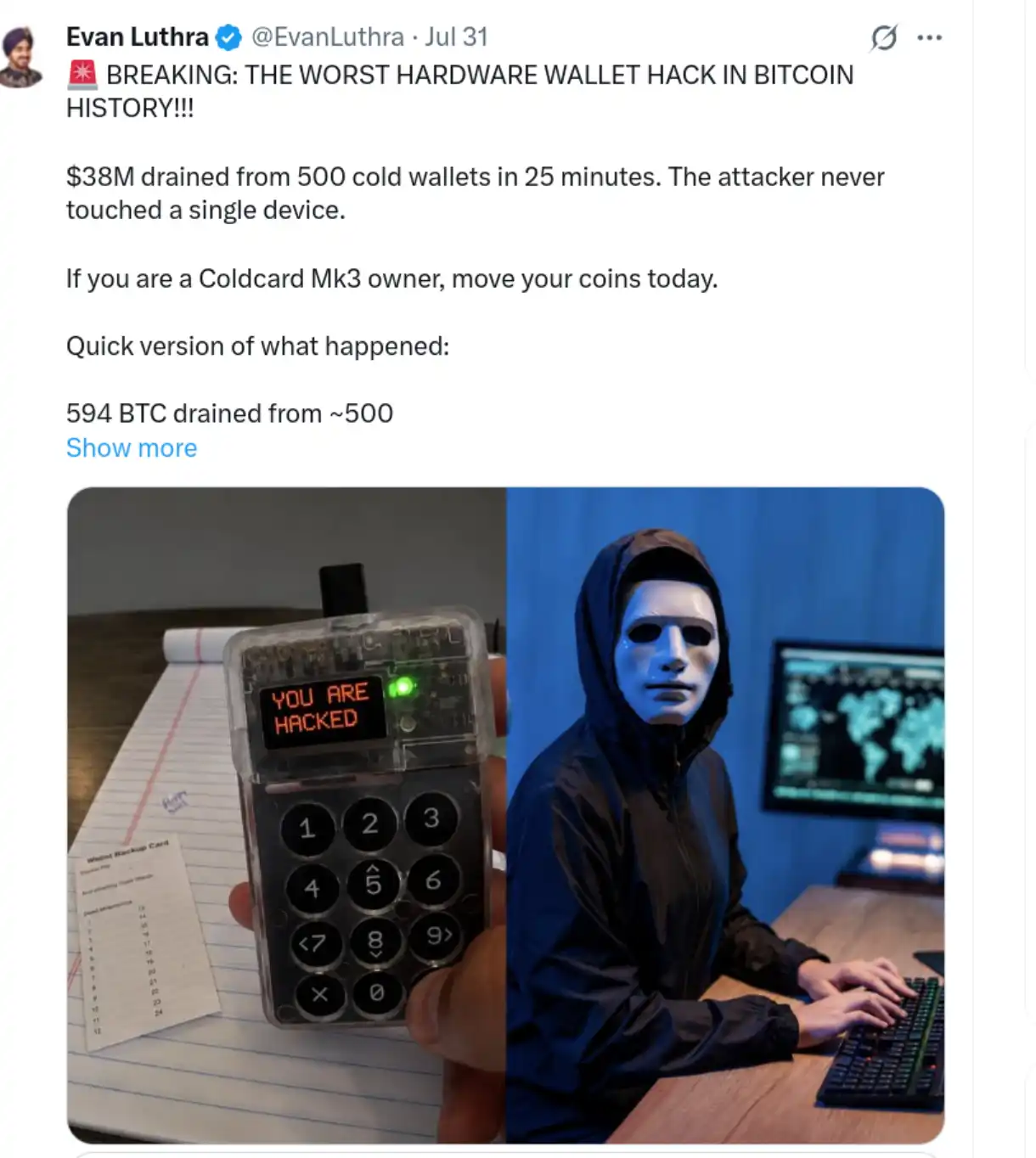
- A Coldcard firmware flaw reportedly exposed wallet recovery seeds, enabling large-scale Bitcoin theft.
- The exploit shows that secure key generation is just as important as offline storage.
- The incident could accelerate stronger firmware audits and wallet security standards.
For years, hardware wallets have been promoted as the gold standard for protecting Bitcoin. Disconnecting private keys from the internet was supposed to eliminate the biggest threat facing crypto investors.
Yet the recent Coldcard exploit demonstrates that security is only as strong as the randomness used to create a wallet in the first place. In this case, attackers reportedly never needed to hack the devices themselves—they simply exploited predictable wallet seeds, draining millions of dollars worth of Bitcoin.
The Hidden Foundation of Every Crypto Wallet
Every crypto wallet begins with a recovery phrase.
Most users assume these 12 or 24 words are completely random, making them effectively impossible to guess. That randomness—or entropy—is what protects billions of dollars in digital assets.
According to researchers, certain Coldcard firmware versions occasionally generated seeds with significantly less randomness than intended after falling back to a predictable software random number generator. Rather than breaking Bitcoin’s encryption, attackers reportedly reconstructed wallet seeds by searching through a much smaller range of possible combinations.
The incident serves as a reminder that cryptography is only as secure as the quality of the randomness behind it.
Why This Matters Beyond Coldcard
Although the vulnerability affected specific firmware versions, the implications extend well beyond a single hardware wallet manufacturer.
The attack reinforces several realities about self-custody.
First, offline storage does not eliminate every risk. Hardware wallets reduce exposure to phishing, malware and exchange failures, but they still depend on secure firmware and proper key generation.
Second, software quality matters just as much as hardware design. A tiny bug in a wallet’s firmware can undermine protections that users assume are mathematically unbreakable.
Finally, security isn’t a one-time purchase. Firmware updates, independent security audits and responsible disclosure remain essential parts of protecting digital assets.

Why Attackers Moved So Quickly
Blockchain investigators observed that a significant share of the stolen Bitcoin was drained within minutes.
This suggests the attacker had already prepared infrastructure capable of scanning vulnerable addresses and immediately identifying high-value wallets once recoverable seeds were generated.
Rather than manually targeting individual users, the operation appears to have relied on automation—demonstrating how sophisticated blockchain surveillance has become.
The Bigger Debate Around Self-Custody
The incident has also reignited discussion over one of crypto’s oldest questions:
Should investors trust themselves, or should they rely on regulated custodians?
Supporters of self-custody argue that users retain complete ownership of their assets and avoid counterparty risk.
Critics point out that managing private keys introduces operational risks that many retail investors underestimate.
Ironically, the Coldcard incident doesn’t prove that self-custody is flawed. Instead, it highlights that self-custody requires more than simply buying a hardware wallet—it demands understanding how keys are generated, protected, and backed up.
What Bitcoin Holders Can Learn
For anyone using a hardware wallet, the exploit offers several practical lessons:
- Keep wallet firmware updated.
- Replace recovery seeds generated by affected firmware versions instead of relying only on firmware updates.
- Consider adding additional entropy, such as dice-generated randomness where supported.
- Use a BIP-39 passphrase or multisignature setup to add another layer of protection.
- Follow manufacturer security advisories rather than assuming older wallets remain secure indefinitely.
What This Means for the Hardware Wallet Industry
The exploit is likely to increase scrutiny of wallet manufacturers’ firmware development and testing practices.
Future competition among hardware wallet providers may focus less on physical design and more on independently audited firmware, transparent source code and verifiable randomness during seed generation.
As institutional adoption of Bitcoin continues to expand, confidence in wallet infrastructure could become just as important as confidence in the blockchain itself.
Conclusion
The reported Coldcard exploit is more than another crypto theft—it is a reminder that Bitcoin’s security depends on every layer of the technology stack, not just the blockchain.
While the vulnerability appears limited to specific firmware versions, it underscores a broader reality: strong cryptography cannot compensate for weak randomness. For long-term Bitcoin holders, securing private keys increasingly means understanding not only where they’re stored, but also how they were created.
- Broker
- Min Deposit
- Score
- Visit Broker

- Award-winning Cryptocurrency trading platform
- $100 minimum deposit,
- FCA & Cysec regulated

- 20% welcome bonus of upto $10,000
- Minimum deposit $100
- Verify your account before the bonus is credited


- Fund Moneta Markets account with a minimum of $250
- Opt in using the form to claim your 50% deposit bonus
Learn to Trade
Never Miss A Trade Again

Signal Notification
Real-time signal notifications whenever a signal is opened, closes or Updated

Get Alerts
Immediate alerts to your email and mobile phone.

Entry Price Levels
Entry price level for every signal Just choose one of our Top Brokers in the list above to get all this free.