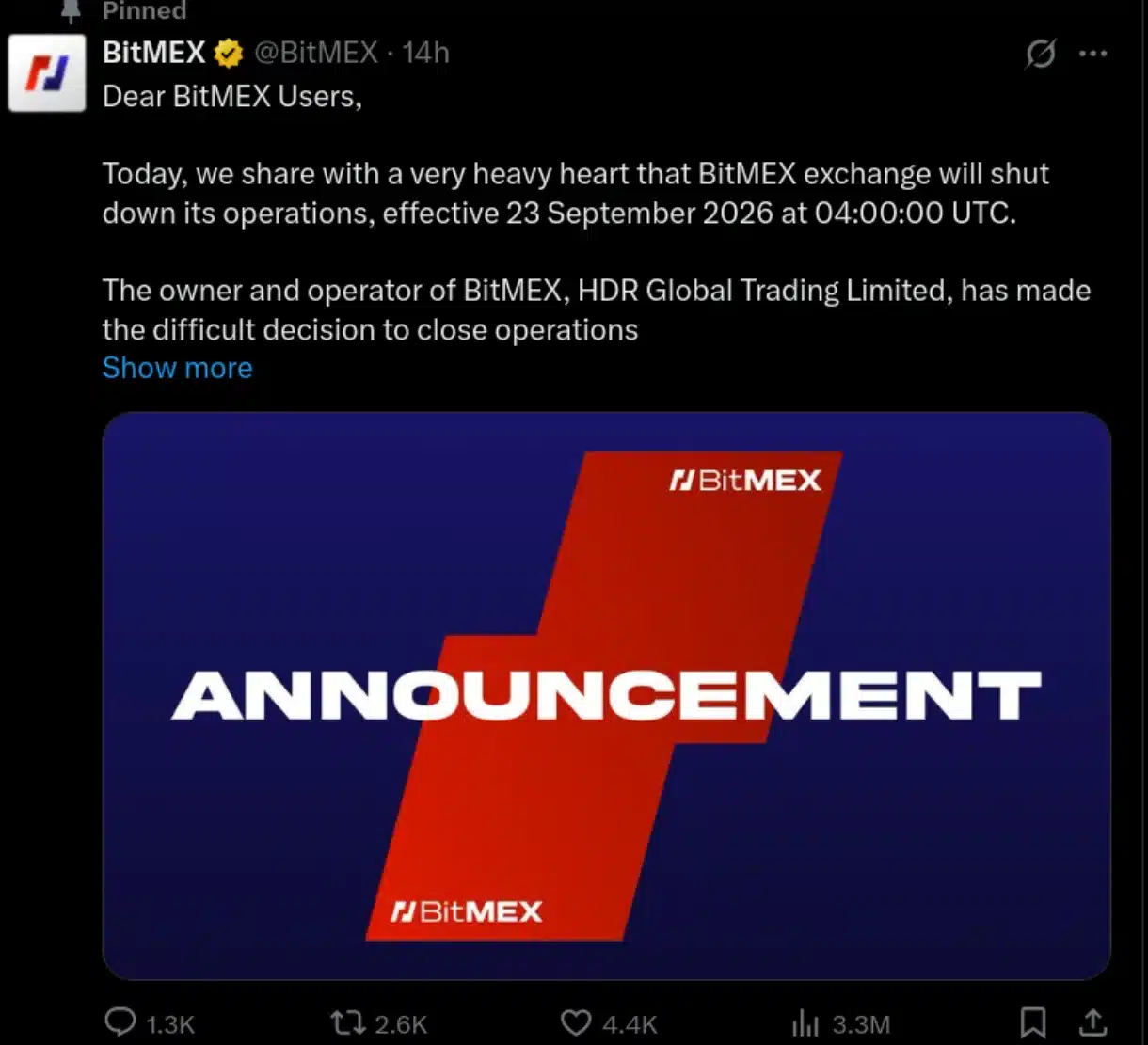
- BitMEX to shut down after 11 years.
- Competition and regulation hastened its decline.
- Exchange consolidation is accelerating
The shutdown of one of crypto’s earliest giants is more than the end of a company—it is a reminder of how quickly leadership can change in the digital asset industry.
BitMEX, once the world’s dominant crypto derivatives exchange, has announced it will wind down operations after more than a decade in business. While the company says the decision followed a strategic review and assures customers that their funds remain secure, its closure raises a much bigger question: Why couldn’t one of crypto’s biggest pioneers survive in an industry it helped create?
The answer lies in how the crypto market has evolved.
From Industry Leader To Market Outsider
Founded in 2014, BitMEX revolutionized crypto trading by introducing perpetual futures contracts, a product that soon became the backbone of digital asset derivatives markets.
At its peak, the exchange handled billions of dollars in daily trading volume and attracted professional traders with its high-leverage offerings. For many years, BitMEX was synonymous with crypto derivatives.
But the market did not stand still.
Over time, rivals such as Binance, Bybit, OKX, and Deribit expanded aggressively, offering more trading products, stronger liquidity, lower fees, and broader global ecosystems. As institutional participation increased, traders gravitated toward exchanges capable of serving both retail and professional clients at scale.
BitMEX gradually lost the dominance it once enjoyed.

Regulation Changed The Competitive Landscape
Another major challenge came from regulation.
Beginning in 2020, BitMEX faced legal action from U.S. authorities over anti-money laundering and compliance failures. Although the company later resolved many of its legal issues and strengthened its compliance framework, the damage to its reputation had already been done.
During those years, competitors continued expanding into new markets, securing licenses, launching additional financial products, and attracting institutional clients.
The episode illustrates how regulatory compliance has shifted from being a competitive disadvantage to becoming a competitive necessity.
Innovation Alone Is No Longer Enough
BitMEX built one of crypto’s most influential financial products, but innovation alone could not guarantee long-term success.
Today’s exchanges compete on far more than trading technology. They are expected to provide spot trading, derivatives, staking, wallets, payment services, institutional custody, regulatory licensing, security infrastructure, and seamless user experiences.
Building a successful exchange now requires an entire financial ecosystem rather than a single breakthrough product.
As larger exchanges continued expanding their offerings, BitMEX struggled to regain its former relevance despite introducing new products and services.
Crypto Is Entering A Consolidation Phase
BitMEX’s closure also reflects a broader trend reshaping the industry.
Liquidity naturally flows toward the largest exchanges because they offer tighter spreads, deeper order books, and greater trading efficiency. As a result, the biggest platforms become even stronger, making it increasingly difficult for smaller competitors to regain market share.
This “winner-takes-most” dynamic has become increasingly evident across the crypto sector.
Rather than signaling weakness in digital assets, BitMEX’s exit highlights how the industry is maturing. Just as traditional finance is dominated by a handful of global exchanges, crypto trading is becoming concentrated among a smaller number of well-capitalized and highly regulated platforms.
What It Means For Investors
For investors, BitMEX’s shutdown should not be viewed as a bearish signal for crypto itself.
Instead, it demonstrates that the industry’s next phase will likely reward companies capable of combining innovation with regulatory compliance, financial strength, and institutional-grade infrastructure.
The broader crypto market continues attracting banks, asset managers, payment companies, and governments exploring blockchain technology. That trend remains intact even as weaker or less competitive businesses leave the market.
BitMEX helped shape modern crypto trading, and its contribution to the industry will not be forgotten. Yet its exit serves as a powerful reminder that in crypto, being first is rarely enough. Long-term success increasingly belongs to firms that can continuously innovate, adapt to regulation, and scale alongside an industry that is rapidly becoming part of the global financial system.
- Broker
- Min Deposit
- Score
- Visit Broker

- Award-winning Cryptocurrency trading platform
- $100 minimum deposit,
- FCA & Cysec regulated

- 20% welcome bonus of upto $10,000
- Minimum deposit $100
- Verify your account before the bonus is credited

- Fund Moneta Markets account with a minimum of $250
- Opt in using the form to claim your 50% deposit bonus
Learn to Trade
Never Miss A Trade Again

Signal Notification
Real-time signal notifications whenever a signal is opened, closes or Updated

Get Alerts
Immediate alerts to your email and mobile phone.

Entry Price Levels
Entry price level for every signal Just choose one of our Top Brokers in the list above to get all this free.