USD/JPY climbed to around 159.70 on Wednesday, its highest level in ten weeks, as hot US inflation data lifted bets on more Fed rate hikes. That leaves the pair just below 160, the zone where Japan last stepped in to buy yen. Traders face a two-sided risk: a wide rate gap lifting the dollar, and possible intervention from Tokyo.
Key takeaways
- USD/JPY rose about 0.5% to roughly 159.65–159.75 by mid-afternoon in London, a ten-week high, after breaking above 159.00.
- Japan’s Ministry of Finance confirmed on 9 November that it spent ¥15.4 trillion buying yen on 30–31 July and 3 August, when the pair was above 160.
- CME FedWatch shows a December Fed hike fully priced, and odds of a January hike jumped to about 60% from 19% before Tuesday’s CPI.
- The dollar index traded near 102.7, close to its 2026 high of 102.94; EUR/USD fell to a two-week low near 1.1116.
- The US bond market is closed for Veterans Day, so liquidity is thinner than usual. US PPI on Friday is the next big test.
Why is USD/JPY rising today?
USD/JPY is rising because markets expect the Federal Reserve to keep raising rates while the Bank of Japan moves more slowly. FXStreet reported the pair up 0.54% at around 159.65 at 14:57 GMT, its highest in ten weeks, after it broke resistance at 159.00. Yahoo Finance data showed it near 159.76 at 15:29 GMT, with a day range of about 158.66 to 159.77.
The trigger was Tuesday’s October CPI report. Headline prices rose 0.4% on the month against a 0.3% forecast, and core rose 0.3% against 0.2%, extending what Reuters called a third straight month of upside surprises. We covered the release itself in yesterday’s CPI report. Today’s story is what happened next: the dollar kept climbing, and the yen took the biggest hit.
The rate gap is still wide
The Fed’s target range is 3.75%–4.00%, while the Bank of Japan’s policy rate is 1.25%, as FXStreet noted. That gap of roughly 2.5 to 2.75 percentage points makes holding dollars more attractive than holding yen. After the CPI data, FXStreet cited CME FedWatch at about 85% for a 25 basis point December hike and 15% for 50 basis points, with odds of another hike in January up to 60% from 19% before Tuesday. Reuters reported that Goldman Sachs now expects hikes in December and March, and Deutsche Bank in December, January and March.
Will Japan intervene to support the yen?
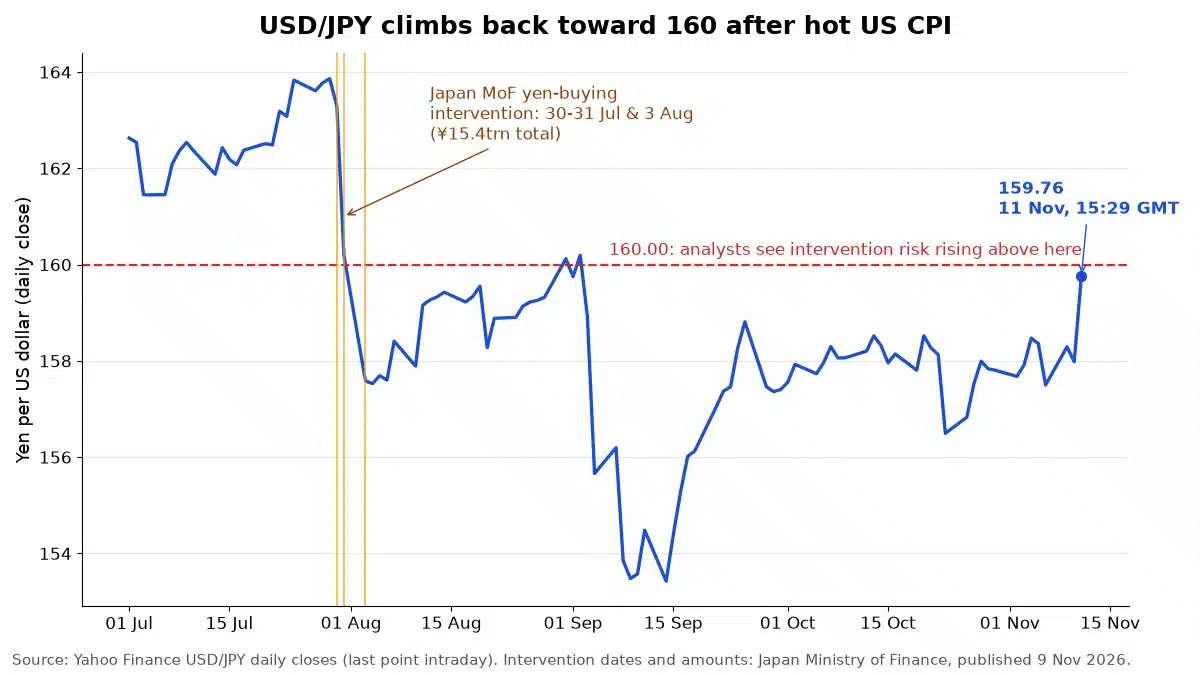
Nobody outside Japan’s Ministry of Finance knows, and Tokyo doesn’t name a trigger level. But the history is clear. The Ministry of Finance confirmed on 9 November that it sold dollars and bought yen on three days: ¥7,975.6 billion on 30 July, ¥5,552.3 billion on 31 July and ¥1,871.4 billion on 3 August, a total of ¥15,399.3 billion. Yahoo Finance price data show USD/JPY closing above 163 just before the first operation and below 158 by 3 August. Reuters described the 31 July action as a rare intervention coordinated with the US. Japan’s top currency diplomat, Atsushi Mimura, said in September that markets should take Tokyo and Washington’s “very clear” message on the yen “at face value”.
The warnings have not stopped. On 2 November, Finance Minister Satsuki Katayama said: “If there are disorderly movements or excessively speculative moves, we will take action,” according to The Japan Times. She also said Japan has been holding discussions with the US “quite frequently”. Tokyo has tied action to the speed and disorder of moves rather than a fixed number, so a fast, one-way slide is more likely to draw a response than a slow drift.
What analysts are watching at 160
Banks see 160 as the line to watch. MUFG’s Derek Halpenny said USD/JPY “has returned closer to the 160-level, above which intervention becomes a much greater prospect”, in a note quoted by FXStreet. ING strategists said they “increasingly think investors will be looking to acquire cheap yen should USD/JPY push above 160 again”. Those are views, not forecasts, and intervention timing has surprised markets before.
Is the Bank of Japan going to hike in December?
A December BoJ hike looks increasingly likely, which could help the yen. The summary of the BoJ’s 29–30 October meeting showed many board members see a near-term hike as necessary, The Japan Times reported. One member said the bank “should decide on the next policy interest rate hike when it is possible without becoming overly cautious.” The next meeting is on 17–18 December, according to the BoJ schedule, about a week after the Fed meets on 8–9 December.
Still, the BoJ raised rates to 1.25% in September and that did not stop the yen from weakening again. The reason, according to Reuters, is that the Fed was hiking too, so the rate gap was not closing quickly.
How are other dollar pairs moving?
The yen is the weakest link, but the dollar is firm across the board. FXStreet put the dollar index (DXY) near 102.70, close to the 2026 high of 102.94 set in October. ING’s Chris Turner said the index could soon retest “big resistance” at 102.85/103.00, Investing.com reported.
| Market | Snapshot (11 Nov) | Source |
|---|---|---|
| USD/JPY | ~159.65, +0.54%, ten-week high (14:57 GMT) | FXStreet |
| US dollar index (DXY) | ~102.70, near 2026 high of 102.94 | FXStreet |
| EUR/USD | ~1.1116, −0.42%, two-week low | FXStreet |
| GBP/USD | ~1.3319, −0.16% (09:20 GMT) | Investing.com |
| US 2-year / 10-year yield | 4.748% / 5.00% (Tuesday settle; cash market shut today) | StoneX |
For the euro, ING’s Turner flagged 1.1110, a 50% retracement level, as a likely area for short sellers to book profits. Follow the pair on our EUR/USD news page and the wider forex news hub. Away from currencies, US stocks were higher, led by chipmakers after CoreWeave’s results, and the stock market is open even though the bond market is closed for Veterans Day, Yahoo Finance reported.
What it means for traders: USD/JPY levels and catalysts
This is market context, not a trade recommendation. Intervention can move USD/JPY several big figures in minutes, and spreads can widen sharply when it happens.
- Resistance: FXStreet’s four-hour chart shows 159.80 first, then 160.40, with 160.00 the round number in focus.
- Support: 159.00 first, then the 100- and 200-period moving averages near 157.90, and a horizontal floor at 157.50, per FXStreet. The four-hour RSI near 72 is in overbought territory.
- Context: Before July’s intervention, the pair traded close to 164. It dropped to about 153.5 in September before recovering, according to Yahoo Finance price data.
- Calendar: US PPI on Friday 13 November at 08:30 ET (13:30 GMT), per the BLS schedule; Fed decision 8–9 December; BoJ decision 17–18 December. Any comment from Katayama or Mimura could move the pair without warning.
Event risk like this is where a plan matters. Our trading-the-news strategy guide covers position sizing around headlines, and the beginners forex course explains how interest rate gaps drive currency pairs. To follow prices, the calendar and research in one place, try the read-only Learn2Trade Terminal free for 14 days; it does not connect to a brokerage account. Educational trade ideas are on our forex signals page. For broker access, one option is AvaTrade. Affiliate disclosure: we may earn a commission if you open an account via this link, at no extra cost to you.
FAQ
Why is the yen falling against the dollar?
The yen is falling because US interest rates are much higher than Japan’s and markets expect the gap to stay wide. Hot US CPI data on 10 November raised bets on Fed hikes in December and January. The Fed’s range is 3.75%–4.00% against the Bank of Japan’s 1.25%.
At what level does Japan intervene in USD/JPY?
Japan does not publish a trigger level. Officials say they act against “disorderly” or “excessively speculative” moves. Japan last bought yen on 30–31 July and 3 August 2026, spending ¥15.4 trillion, when USD/JPY was above 160. Analysts at MUFG and ING see 160 as the key line.
How much did Japan spend on yen intervention in 2026?
Japan’s Ministry of Finance said it spent ¥15,399.3 billion (about ¥15.4 trillion) between July and September 2026: ¥7,975.6 billion on 30 July, ¥5,552.3 billion on 31 July and ¥1,871.4 billion on 3 August. It published the figures on 9 November 2026.
When is the next Bank of Japan meeting?
The Bank of Japan’s next policy meeting is on 17–18 December 2026. The summary of its October meeting suggested many board members see a near-term rate hike as necessary. A hike from 1.25% could support the yen, but the Fed’s path matters just as much.
Are US markets open on Veterans Day?
US stock markets are open on Veterans Day, 11 November 2026, but the US bond market is closed. Currency markets trade as normal, though liquidity can be thinner, which can exaggerate moves.
Risk warning / not financial advice: Trading forex, CFDs, cryptocurrencies and other leveraged products carries a high risk of loss and is not suitable for everyone. You can lose more than your initial deposit when trading leveraged products. This article is for educational and informational purposes only and is not investment, trading or financial advice. Nothing here is a recommendation to buy, sell or hold any instrument. Market levels quoted are snapshots from named sources at the time of writing and may have changed. Past performance is not a reliable indicator of future results. Always do your own research and consider seeking advice from a suitably licensed professional. Affiliate relationships (including AvaTrade) are disclosed above.
- Broker
- Min Deposit
- Score
- Visit Broker

- Award-winning Cryptocurrency trading platform
- $100 minimum deposit,
- FCA & Cysec regulated

- 20% welcome bonus of upto $10,000
- Minimum deposit $100
- Verify your account before the bonus is credited


- Fund Moneta Markets account with a minimum of $250
- Opt in using the form to claim your 50% deposit bonus